
The Hygge Handbook: Decorate Your Way to Comfort, Happiness, and Well-Being
We’ve spent several chapters talking about how to transform your physical space into a hygge haven, but here’s the beautiful truth about hygge: it’s ultimately not about the stuff. It’s about how you live, how you connect, and how you create moments of comfort and joy in everyday life. This final chapter brings everything together and explores how hygge extends far beyond home decor into a way of being.
Creating a hygge home is wonderful, but if you're still rushing through life stressed and disconnected, you're missing the point. The Danes understand that hygge is a practice, not a Pinterest board. It's about presence, intentionality, and choosing comfort and connection over constantly striving for more. In this chapter, we're going to explore how to actually live the hygge life you've been creating a backdrop for.
Let’s start with the concept of hygge rituals. These are the small, repeated practices that anchor your day and create pockets of peace in otherwise hectic schedules. We’ll explore morning routines that set a calm tone for your day, evening wind-down practices that help you transition from work mode to home mode, and weekend rituals that make your time off truly restorative. These aren’t complicated or time-consuming practices. They’re simple moments of intentionality that compound over time.
The art of slowing down is central to hygge living. In our culture that glorifies busy, choosing to move more slowly can feel revolutionary. We’ll discuss practical strategies for building in pauses, saying no to things that don’t serve you, and protecting your time and energy. You’ll learn how to create breathing room in your schedule, resist the pressure to constantly optimize and improve, and find contentment in simply being rather than always doing.
Social hygge is about quality connections over quantity of interactions. The Danes are masters at creating intimate gatherings that prioritize real conversation and genuine connection. We’ll explore how to host hygge gatherings in your newly cozy home, from simple dinner parties to afternoon tea with a friend. You’ll get practical tips for making guests feel truly welcome without stressing yourself out trying to be the perfect host.
Technology and hygge have an interesting relationship. While screens can certainly interfere with hygge moments, we’re not going to pretend you should toss your phone in a drawer and never look at it. Instead, we’ll discuss realistic strategies for using technology intentionally, creating phone-free zones and times, and finding balance between staying connected digitally and being present in your physical space. You’ll learn how to make technology work for your hygge life rather than against it.
Self-care takes on new meaning when viewed through a hygge lens. It’s not about expensive spa days or elaborate beauty routines. Hygge self-care is simple, accessible, and focused on genuine comfort. We’ll explore everything from creating cozy bath rituals to establishing reading practices, from developing a relationship with your kitchen to finding movement practices that feel good rather than punishing. The emphasis is on treating yourself with the same kindness and consideration you’d show a good friend.
Food and hygge are deeply connected. While we haven’t talked much about kitchens and dining spaces in previous chapters, the hygge approach to food deserves attention. It’s about simple, comforting meals enjoyed slowly rather than grabbed on the run. We’ll discuss creating relaxing cooking experiences, the pleasure of baking something that makes your home smell amazing, and turning ordinary meals into mindful moments of nourishment and pleasure.
Hygge and nature have a strong connection that extends beyond bringing natural materials into your home. We’ll explore how to incorporate outdoor time into your hygge life, from forest bathing to simple neighborhood walks. Even if you’re not particularly outdoorsy, there are ways to connect with nature that support the hygge philosophy of finding contentment in simple pleasures.
Mindfulness and hygge naturally complement each other. While hygge isn't explicitly a mindfulness practice, it shares many of the same principles: being present, savoring simple moments, and finding contentment in what is rather than what could be. We'll discuss gentle ways to incorporate more presence into your daily life without adding pressure to meditate perfectly or achieve some enlightened state.
The sustainability angle of hygge is worth exploring too. The emphasis on quality over quantity, natural materials over synthetic, and finding contentment with less rather than constantly acquiring more aligns beautifully with sustainable living. You’ll discover how hygge principles naturally lead to more environmentally conscious choices without requiring you to become an extreme minimalist or zero-waste warrior.
Finally, we’ll address how to maintain your hygge life when things get tough. Life isn’t always cozy and comfortable, and hygge isn’t about denying difficult realities. Instead, it’s about creating anchors of comfort and calm that help you weather storms. You’ll learn how to lean into hygge practices during stressful periods, use your space as a true sanctuary when you need it most, and maintain perspective when everything feels overwhelming.
By the end of this chapter and book, you’ll understand that creating a hygge home is really about creating a hygge life. The cozy blankets and soft lighting are wonderful, but they’re ultimately in service of something bigger: a life that prioritizes well-being, connection, and contentment. You’ll have both the practical tools to transform your space and the philosophical framework to transform how you live in that space. That’s when hygge truly comes alive, and that’s when you’ll understand why this Danish concept has captured hearts around the world.
Daily Rituals and the Art of Slowing Down
Here’s what most people get wrong about hygge: they think it’s something you do once in a while when you light a candle and curl up with a book. But real hygge is woven into the fabric of your everyday life through small, intentional rituals that remind you to slow down and be present. These aren’t grand gestures or time-consuming ceremonies. They’re simple practices that create little islands of calm in your day, anchoring you when everything else feels chaotic. The Danes have mastered the art of making ordinary moments feel special, not by adding complexity but by removing the rush. When you stop treating your mornings like a race against the clock and your evenings like a countdown to collapse, something shifts. You start actually living your life instead of just getting through it.

Morning Rituals That Set the Tone
Your morning sets the trajectory for your entire day, so why do we treat it like an emergency evacuation? A hygge morning isn’t about waking up at 5 AM to meditate and journal for an hour. It’s about building in just enough time to transition from sleep to the day ahead without feeling like you’re being chased.
Maybe it’s sitting with your coffee for ten actual minutes instead of drinking it in the car. Maybe it’s making your bed as a small act of care for your future self. Some people light a candle while they get ready, creating a sensory marker that this time is different from the rushed hours ahead. Others put on music they love instead of immediately checking their phones.
The key is consistency and intention. Pick one or two small practices that feel genuinely good to you, not things you think you should do because they sound hygge. If you hate mornings, don't force yourself into an elaborate routine. Even opening your curtains to let in natural light and taking three deep breaths counts. The point is to start your day as a human being with needs and feelings, not as a productivity machine that needs to boot up as quickly as possible.
Evening Wind-Down Practices
The transition from work mode to home mode is where a lot of us struggle. We physically leave the office or close our laptops, but mentally we're still in go-mode, our brains spinning with everything we didn't finish and everything waiting for us tomorrow. Creating an evening wind-down ritual helps you actually arrive home instead of just being there physically while your mind stays elsewhere.
This might look like changing into comfortable clothes immediately when you get home, a practice the Danes take seriously. It’s not about being lazy; it’s about signaling to your body that you’re in a different space now. Some people make tea and sit in their favorite chair for fifteen minutes before starting dinner. Others take a short walk around the block to create a physical transition between work and home.
The ritual might involve lighting candles throughout your space, turning on soft music, or simply putting your phone in another room for an hour. What matters is that you have some kind of buffer zone between the demands of your day and your personal time. Your evening ritual tells your nervous system that it's safe to relax now, that you don't need to stay in high-alert mode anymore.
Weekend Rituals and Protected Time
Weekends have become just another opportunity to be productive, to catch up on everything we didn’t get done during the week, to optimize and improve ourselves. The hygge approach is radically different: weekends are for actual rest and enjoyment, not just a different kind of work.
This means creating rituals that make your time off feel genuinely restorative. Maybe Saturday mornings are for slow breakfasts that you actually cook and eat at the table instead of grabbing something quick. Maybe Sunday afternoons are protected reading time where you’re not available for errands or obligations. Some people have a Friday night ritual of takeout and a movie to mark the end of the work week.
The important thing is protecting at least some of your weekend from the tyranny of productivity. You don't have to earn rest by first completing everything on your to-do list. Rest is what makes everything else possible. When you consistently honor your weekend rituals, you start to feel the cumulative effect. You're not constantly running on empty, trying to recharge just enough to make it through another week.
Social Connection and Mindful Technology Use
One of the most beautiful aspects of hygge is how it brings people together in meaningful ways. But let’s be honest: our phones are often the third wheel in every interaction, constantly pulling our attention away from the people right in front of us. The Danish concept of hygge gatherings isn’t about impressing anyone or creating Instagram-worthy moments. It’s about genuine connection, real conversation, and being fully present with the people you care about. At the same time, we live in a digital world, and pretending we can just opt out completely isn’t realistic for most of us. The hygge approach to technology isn’t about total elimination but about intentional use. It’s about making sure technology serves your life rather than running it. This section explores how to create real connection in an age of constant digital distraction, and how to find a realistic balance that works for your actual life.

Hosting Hygge Gatherings
The pressure we put on ourselves when hosting is exhausting. We think we need the perfect menu, the perfectly decorated space, and everything to go flawlessly. But hygge gatherings are the opposite of that stress. They're about creating an atmosphere where everyone feels comfortable and welcome, where conversation flows naturally, and where the focus is on connection rather than performance.
Start by keeping things simple. A pot of soup and good bread can be more hygge than an elaborate three-course meal that leaves you too stressed to enjoy your own party. Set the mood with candles and soft lighting, not because it looks good but because it naturally creates a more intimate, relaxed atmosphere. Put on background music at a volume that allows conversation. Create cozy seating arrangements that encourage people to actually talk to each other instead of standing around awkwardly.
Here's a game-changer: establish a phone-free gathering. Not in a preachy way, but just by example. When everyone knows they're not competing with screens for attention, the quality of interaction completely changes. Keep the guest list small and intentional. Four people having a real conversation beats a packed house where everyone's making small talk.
Creating Phone-Free Zones and Times
We need to talk about phones because they're the biggest obstacle to hygge living. You can't be present when you're constantly checking notifications, and presence is at the heart of hygge. But most advice about phone use is either unrealistic or overly prescriptive. Let's find a middle ground that actually works.
Start by creating physical phone-free zones in your home. The bedroom is an obvious one. Keeping phones out of your sleeping space improves sleep quality and protects your morning and evening rituals from immediate digital intrusion. Many people also make the dining table phone-free, whether eating alone or with others. This one simple rule transforms meals from mindless refueling into actual experiences.
Time-based boundaries work well too. Maybe the first hour after you get home from work is phone-free, allowing you to actually transition into your personal time. The key is making these boundaries specific and consistent so they become habits rather than decisions you have to make every time. Notice when you're using your phone intentionally versus habitually, and work on reducing the habitual use.
Quality Over Quantity in Social Life
Our culture often measures social success by how many friends you have and how packed your social calendar is. The hygge approach is completely different: it values depth over breadth, intimacy over activity. It's better to have a few close relationships where you can truly be yourself than dozens of surface-level connections that leave you feeling lonely even when surrounded by people.
This might mean saying no to social obligations that don’t genuinely feed your soul. It definitely means being more selective about how you spend your social energy. When you do spend time with people, make it count. Put your phone away. Ask real questions and actually listen to the answers. Create space for silence and depth rather than filling every moment with chatter or activity.
Some of the most hygge social moments happen when you're just existing together, reading in the same room, cooking side by side, or taking a walk without feeling the need to constantly entertain each other. And don't underestimate the value of solitude. Sometimes the most hygge thing you can do is spend time alone, recharging in your cozy space without the demands of social interaction.
Self-Care, Food, and Connecting with Nature
Self-care has become such a buzzword that it’s almost lost all meaning. We’ve turned it into another thing on our to-do list, another way we’re supposed to optimize and improve ourselves. But hygge self-care is different. It’s not about punishment disguised as wellness or expensive products marketed as essential. It’s about genuine comfort, nourishment, and care that feels good in the moment and supports your well-being over time. This includes how you feed yourself, how you move your body, and how you connect with the natural world. The hygge approach to all these things is gentle, accessible, and focused on pleasure rather than perfection. You’re not trying to earn worthiness through green juice and marathon training. You’re simply taking care of yourself with the same kindness you’d show someone you love.
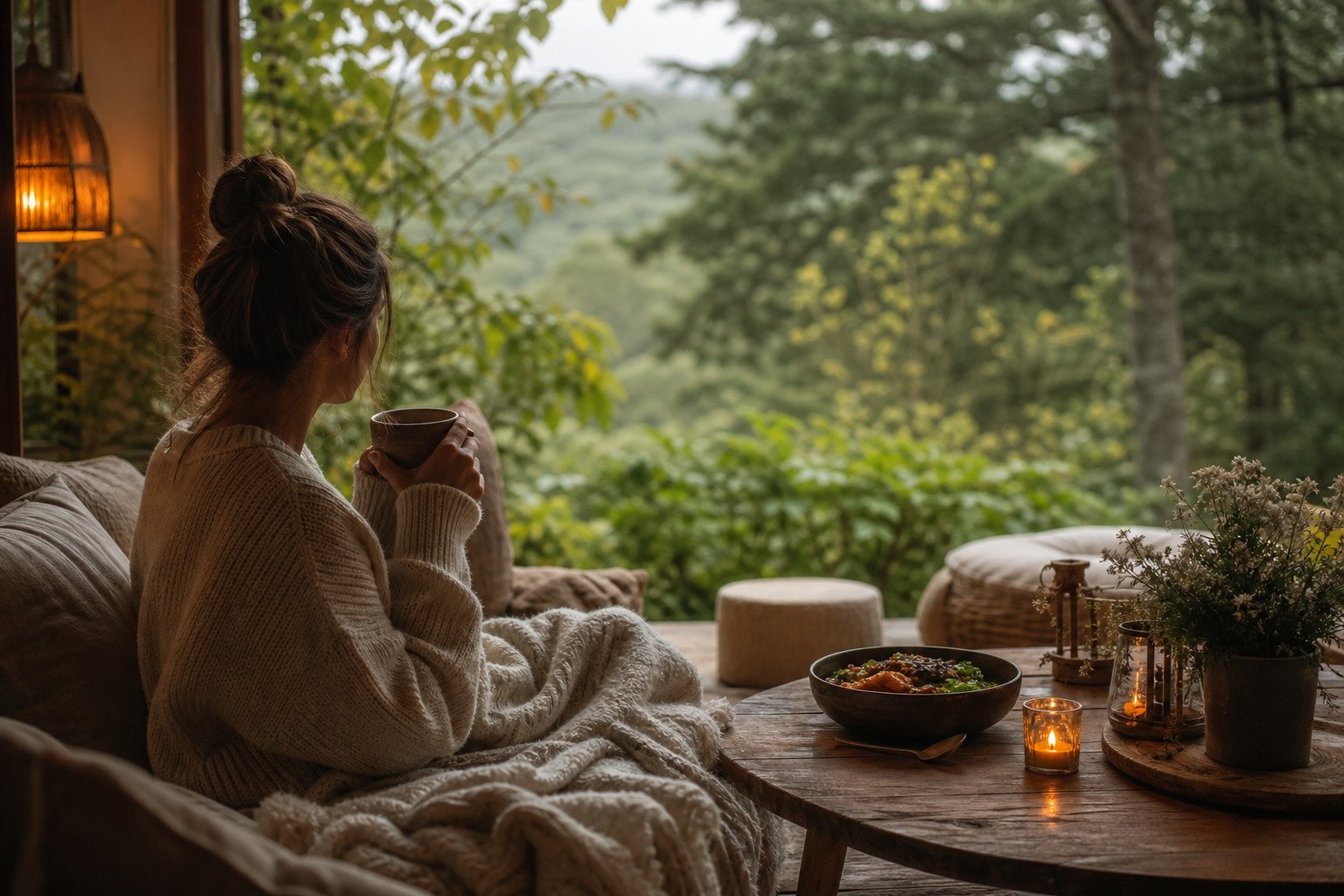
Hygge Self-Care Practices
Real hygge self-care is wonderfully simple. It’s a bath with good lighting and maybe a book, not a complicated multi-step routine with expensive products. It’s sitting down to actually read for pleasure, not forcing yourself through self-improvement books you think you should read. It’s taking a nap when you’re tired instead of pushing through with more caffeine.
The revolutionary thing about hygge self-care is that it doesn't require justification. You don't have to earn a cozy evening. You don't have to be productive enough to deserve rest. Comfort and care are not rewards for good behavior; they're basic human needs.
Some practical hygge self-care practices include creating a proper bedtime routine that helps you wind down, not just collapsing into bed when you can’t keep your eyes open anymore. It might mean investing in genuinely comfortable loungewear that makes you feel cozy rather than frumpy. Many people find that having a special cup or mug for their morning coffee or tea adds a small dose of pleasure to the everyday.
Reading becomes more hygge when you have a dedicated reading spot with good lighting and comfort. The bath or shower can be transformed from a rushed necessity into a genuine ritual with good products, candles, and taking your time. Movement practices count as hygge self-care when they feel good rather than punishing. This might be gentle yoga, walking, dancing in your living room, or stretching. The emphasis is on how your body feels, not on burning calories or achieving fitness goals. And sometimes hygge self-care is simply giving yourself permission to do nothing.
The Hygge Approach to Food and Cooking
Food is central to Danish hygge, but not in a complicated or perfectionist way. It’s about the comfort of simple, delicious meals and the pleasure of preparing and eating them without rush. Hygge cooking isn’t about elaborate recipes or Instagram-worthy presentations. It’s about soup simmering on the stove, bread baking in the oven, the simple satisfaction of feeding yourself and others well.
The smell of something good cooking is itself a hygge experience, filling your home with warmth and anticipation. Start by slowing down your relationship with food. Instead of eating at your desk or standing at the counter, sit down for meals. Use real plates, not containers. Light a candle even if you're eating alone. These small acts transform eating from refueling into an actual experience.
Cooking becomes more hygge when you remove the pressure to be perfect or efficient. Put on music you love. Pour yourself something to drink. Let it take the time it takes. Baking is particularly hygge, maybe because it fills your home with amazing smells and creates something tangible and comforting.
The food itself follows hygge principles: comforting, nourishing, often simple. Think stews and roasted vegetables, warm porridge, fresh bread with butter, hot chocolate on cold days. Nothing too fancy or fussy, just good food that makes you feel taken care of. Sharing meals is hygge too, whether cooking together with a partner or having friends over for a casual dinner.
Nature Connection and Mindful Living
The Danes spend a lot of time outdoors despite their cold, dark winters, and this connection to nature is part of hygge philosophy. You don’t have to become an outdoorsy person to incorporate this element into your life. Even small doses of nature contact can be grounding and restorative. This might be as simple as taking a walk around your neighborhood and actually noticing your surroundings instead of being lost in your thoughts or phone.
The Scandinavian concept of friluftsliv, or open-air living, is about being outside in all weather, appropriately dressed and comfortable. There's something about fresh air and natural light that no amount of cozy indoor time can replace. Even in your hygge home, connecting with nature matters. Open your curtains to let in natural light. Open windows when weather allows for fresh air. Notice the seasons changing.
Mindfulness ties into all of this because hygge is ultimately about presence. You can practice mindfulness without meditating perfectly or achieving some zen state. It’s as simple as paying attention to what you’re doing while you’re doing it. Noticing the taste of your food. Feeling the warmth of your mug in your hands. Hearing the rain against your window.
These small moments of presence accumulate into a life that feels richer and more satisfying. The beautiful thing is that your hygge home naturally supports this mindfulness. When your environment is comfortable and calming, it's easier to be present in it. And when things get tough, these practices become genuine anchors to help you through.