You want to level up your life, but your brain feels like 47 tabs open and one’s blasting mystery music? Enter the vision board. It’s not magic; it’s clarity you can see. When you design a future board with self-care at the center, you create a daily reminder to act like the person you’re becoming—not the one who doom-scrolls past midnight. Let’s build a board that supports your self-improvement, looks cute, and actually works.
Why Vision Boards Work (When You Build Them Right)
Vision boards work because they translate fluffy goals into visual cues your brain recognizes. We like pictures. We like simple. We like “oh yeah, that’s what I’m doing today.” That constant nudge helps you choose aligned actions—like going for a walk instead of melting into the couch.
Key benefits you actually feel:
- Focus: You see your priorities daily, so they stay top of mind.
- Motivation: Small wins feel bigger because you’re tracking them visually.
- Decision support: If it doesn’t fit the board, it probably doesn’t fit your life right now.
- Confidence: You watch your identity shift from “trying” to “doing.”
Start With Your Why (Then Trim the Fluff)
Before you print a single aesthetic photo, get clear on what you actually want to feel. Not “run a marathon” or “read 52 books.” Try “feel energized,” “feel grounded,” “feel proud of my routines.” You can translate those into actions later.
Quick exercise:
- Write down three feelings you want more of.
- For each feeling, list two habits that create it.
- Turn those habits into visuals and short phrases for your board.
Examples to steal
- Calm: Ocean photo, “10-minute morning breathwork,” soft blue palette.
- Strength: Trail shoes, “3x week strength,” a sweaty-but-happy selfie vibe.
- Connection: Tea with a friend, “text one person daily,” warm color tones.
Choose Your Board Format Like a Pro
You’ve got options. Pick the one you’ll actually see and update. IMO, the best board is the one that interrupts your autopilot.
- Physical board: Corkboard or poster. Pros: tactile, fun to assemble. Cons: takes space.
- Digital board: Canva, Notion, Pinterest, or your phone wallpaper. Pros: portable, easy to edit. Cons: out of sight if you bury it in folders.
- Hybrid: One physical anchor (bedroom wall) + digital micro-boards (phone lock screen).
Visibility hacks
- Place it where you make decisions: desk, kitchen, or closet.
- Set it as your phone lock screen. You’ll see it 3,000 times a day. FYI, that’s the point.
- Calendar a monthly “refresh” so it evolves with you.
Build Your Future Board: The Self-Care Core
Let’s assemble a board that treats self-care as the fuel for growth, not a bubble bath bandaid. Include images, words, and tiny rituals that make improvement sustainable.
What to include:
- Identity anchors: “I am a person who…” statements. Example: “I am a person who keeps promises to myself.”
- Keystone habits: The smallest actions that trigger bigger wins: 8 hours sleep, 20-minute walks, 10-minute tidy.
- Energy rituals: Hydration, morning light, stretch breaks, creative play.
- Boundaries: “No is a full sentence,” “Screen-free after 9 PM,” “Meetings end on time.”
- Progress snapshots: A habit tracker, checkboxes, or mini-milestones you can mark off.
- Self-talk upgrades: Short phrases: “Progress over perfect,” “Start where your feet are.”
Design tips for brain-friendly focus
- Group items by theme: Energy, Mind, Body, Work, Relationships, Money.
- Use a simple color palette so your eyes stop on the important stuff.
- Mix images and words: pictures hook emotion, words clarify intent.
- Keep 20% of the board blank. Space = calm. Your nervous system will thank you.
Make It Actionable (Tiny Steps > Vague Dreams)
Dreams need handles. Turn your visuals into micro-actions you can take today. No “be better,” only “do this.”
Translate images into commitments:
- Picture of a sunrise → “Outside by 7:30 AM, 10-minute walk.”
- Photo of a journal → “Three lines a day: one win, one worry, one next step.”
- Healthy meal photo → “Prep two lunches on Sunday.”
- Cozy bed image → “Phone sleeps outside the bedroom.”
2-minute rule
If a step takes under two minutes, do it now. Fill your water bottle. Lay out workout clothes. Open the book. Small actions reduce friction and build momentum. It’s like hacking your future self’s laziness (lovingly).
Keep It Real: Sustainable Self-Care Only
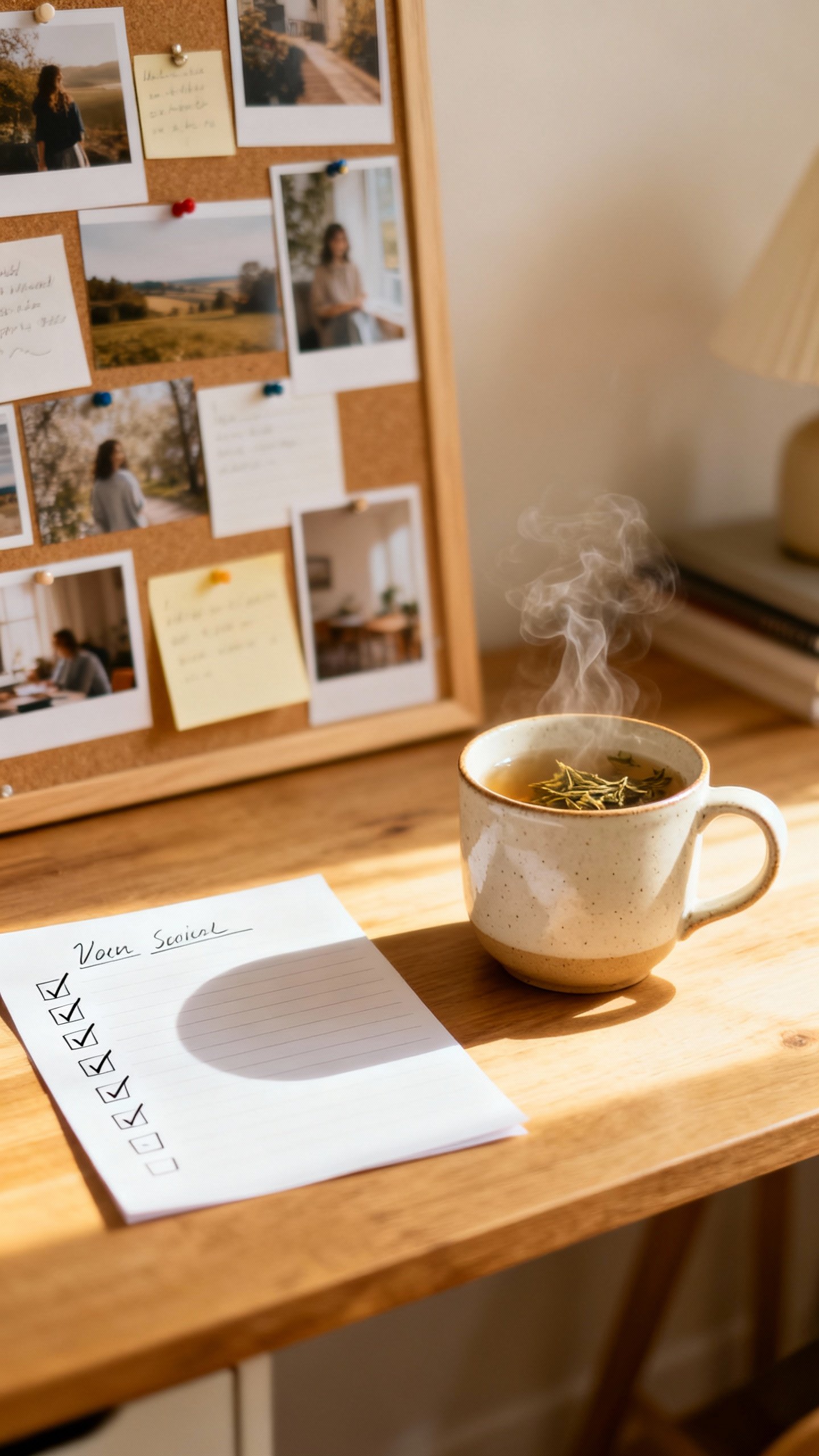
You don’t need a monk’s schedule. You need repeatable, imperfect practices that survive your busiest days. No gold stars for misery.
How to set “kind but firm” goals:
- Set floors, not ceilings: “Read 2 pages” not “read 30.” Floors make you consistent; ceilings stunt motivation.
- Anchor habits: Pair new habits with existing routines: stretch while coffee brews.
- Choose constraints: “Two social events per week max” beats burnout by Wednesday.
- Plan for messy days: Have a backup version: “1-minute breathwork if I miss my morning routine.”
Refresh, Reflect, Repeat
Your board should evolve as you do. If a section feels stale, update it. If a goal never gets love, either shrink it or replace it—no guilt, just data.
Monthly check-in prompts:
- What felt easy and energizing? Do more of that.
- What felt heavy or forced? Edit or delete.
- What small win deserves a visual celebration? Add it to the board.
- What identity shift started? Name it and commit to it.
Track feelings, not just outputs
Record how your habits change your mood, focus, and relationships. When you see the emotional ROI, you’ll stick to the habits. IMO, feelings data beats arbitrary metrics every time.
Common Aesthetic Themes (And How to Make Them Yours)
A cute board helps, but form follows function. Pick a vibe that supports your nervous system and your goals.
- Soft Minimal: Neutrals, whitespace, clean fonts. Great for overthinkers who need calm.
- Vibrant Energy: Bright colors, bold quotes, movement. Great for morning motivation.
- Nature Grounded: Forests, ocean, earth tones. Perfect for balance and routine building.
- Cozy Growth: Warm hues, mugs, blankets, plants. Encourages gentle consistency and rest.
Quick curation checklist
- Does each item map to a habit, boundary, or feeling?
- Can I explain why this is here in one sentence?
- Will Future Me roll their eyes at this? If yes, delete.
FAQ
Do I need fancy supplies or design skills?
Nope. You need clarity, scissors (or a mouse), and a willingness to choose. Fancy boards don’t beat focused boards. If you can drag and drop or cut and paste, you’re set.
How often should I update my vision board?
Do a light refresh monthly and a deeper reset each season. Swap images that don’t resonate, upgrade habits that got easier, and celebrate wins. Treat it like a living document, not a museum piece.
Can I make multiple boards for different areas of life?
Yes, but keep one master board or theme to unify them. Too many boards can scatter your focus. Try topical micro-boards (health, work, relationships) that all ladder up to one core feeling, like “steady” or “energized.”
What if I feel silly making one?
Cool, make it anyway. Feeling silly means your brain noticed a pattern break. That’s growth arriving. Keep it private if you want, but don’t let embarrassment block progress.
Will a vision board replace goal setting?
It complements goals. The board gives you direction and emotional fuel; goals and systems deliver results. Pair visuals with weekly planning and tiny actions for the win.
How do I avoid turning it into a perfection shrine?
Include “messy is allowed” cues: crossed-out boxes, imperfect photos, sticky notes. Add a rule: nothing belongs if it requires you to be a different person overnight.
Wrap-Up: Build the Board, Become the Person
Your vision board isn’t about manifesting a perfect timeline. It’s about reminding yourself—daily—what matters and who you’re practicing to be. Keep self-care at the center, translate dreams into tiny actions, and let your board evolve as you do. Start small, pin one habit, and watch your future self say “FYI, we did that.”