
You’re not lazy—you’re overwhelmed. And staring at a blank year, you either want to redesign your life or at least find your keys. A vision board can help with both. It turns “someday” into “here’s the plan” and gives your brain a neon sign to follow. Ready to build a visual compass that actually makes you move?
Why Vision Boards Work (No, It’s Not Magic)
Your brain loves pictures. When you show it images tied to your goals, it starts filtering opportunities that match. That’s the Reticular Activating System doing its job—kind of like your inner algorithm.
Also, visuals make your goals feel real. You’ll think, “I travel. I save. I lift heavy things.” That identity shift beats willpower every time. And if you need cold logic: a clear target + daily reminder = better decisions.
The Motivation Equation
Motivation shows up when you:
- Know exactly what you want (specific goals).
- See it daily (visual cues).
- Take small steps (tiny wins feed confidence).
That’s the vision board trifecta. FYI, “manifestation” works best when you also send a calendar invite to your habits.
Pick a Theme: Your Life, but Curated
Random cutouts look cute, but themes create momentum. Choose 1–3 pillars for the next 6–12 months. You’ll focus better, and you won’t build a collage of chaos.
- Career + Money: promotions, freelance income, debt-free vibes.
- Health + Energy: strength goals, sleep, mental clarity.
- Relationships: deeper friendships, dating, family rhythms.
- Lifestyle: travel, home design, hobbies that don’t involve doomscrolling.
- Creativity: art, writing, side projects, music.
Set a Time Horizon
Decide if this is a 90-day sprint or a 12-month arc. Shorter horizons feel doable. Longer horizons allow bigger dreams. Both work. IMO, start with 6 months so you see traction fast.
Gather Inspo: Hunt Like a Designer
You’ll need images, words, textures—things that spark emotion. If it makes your shoulders drop or your heart race, it goes in the pile.
- Sources: magazines, Pinterest boards, Unsplash, Instagram saves, your camera roll.
- Words & Phrases: quotes that actually motivate you, not the corny stuff you’d avoid at the gym.
- Numbers: income goals, savings amounts, reps, miles—specifics matter.
- Textures: fabric swatches, paint chips, ticket stubs—give your board some dimension.
Digital vs. Physical
– Physical: poster board, corkboard, or a frame. Tactile and visible. You’ll walk by it and get called out by your own dreams.
– Digital: Canva, Notion, or your phone wallpaper. Portable and easy to update. Bonus: make it your lock screen so it’s the first thing you see, not your inbox.
Design It: Make Your Board a Story, Not a Collage
Don’t just glue stuff randomly. Layout affects focus. Tell a story from center to edges.
- Center = your main theme or word of the year.
- Quadrants = categories (health, career, relationships, lifestyle).
- Top area = “identity” shots (who you’re becoming).
- Bottom area = “process” images (habits and actions).
Add Action Anchors
Under each image, add a tiny label with the next step. Example:
- Beach photo → “Book PTO by Feb 10.”
- Dumbbells → “3 workouts/week, Mon-Wed-Fri, 30 min.”
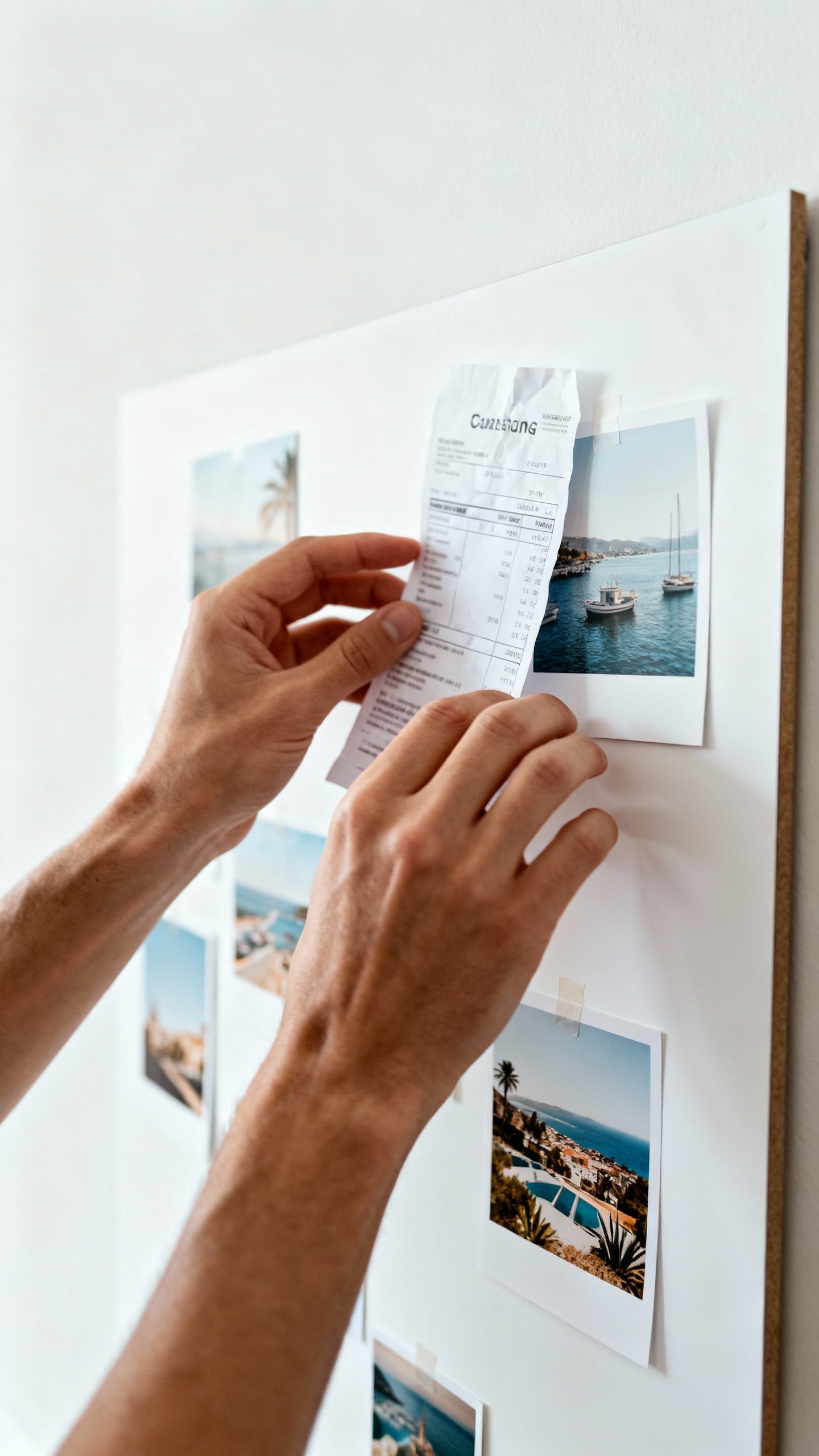
- Invoice screenshot → “Pitch 5 clients by March 1.”
This turns vibes into velocity. Motivation loves clarity.
Self-Motivation Hacks to Keep You Moving
You built the board. Now make it work for you even when your mood doesn’t.
- Habit Pairing: glance at your board while you drink coffee. Say out loud one action for the day. Yes, talk to it. You talk to your plants, right?
- Time-Block by Theme: Mondays = outreach, Tuesdays = creative, Wednesdays = learning. It reduces decision fatigue.
- 2-Minute Rule: if you procrastinate, do a micro-step: open the email draft, put on shoes, pull up the worksheet.
- Progress Parking: end each day by writing the next “tiny next step” on a sticky note and slap it on the board.
- Celebrate Small Wins: star stickers, checkmarks, a goofy victory dance—whatever signals your brain that effort counts.
Build a “When-I-Don’t-Feel-Like-It” Kit
– A 10-song playlist that flips your mood.
– A 15-minute “bare minimum” workout or task list.
– Screenshots of past wins to remind you you’re not a potato.
– A text to your accountability buddy that says, “I’m stuck—give me one micro-action.” IMO, this alone can save a week.
Prompts to Find Your Vision (If You’re Blank)
Ask yourself sharper questions. Vague desire equals vague results.
- What do I want to feel at 7 a.m., 2 p.m., and 9 p.m.?
- What does “enough” money look like monthly? Where does it go?
- Which three habits would make everything else easier?
- What do I want more of this year? What do I want less of?
- What am I willing to trade for this goal? Time, comfort, scrolling?
Translate Prompts into Board Items
– Feeling calm at 7 a.m. → sunrise image, “no phone till coffee,” cozy corner photo.
– Enough money → bank app screenshot, $X saved/month, “Friday finance date.”
– Stronger body → lifting photo, “progressive overload plan,” protein goals.
Keep It Fresh: Review, Remix, Repeat
Your goals evolve. Let your board evolve too. If a picture no longer resonates, swap it. If a habit works, double down.
- Weekly check-in: What moved? What stalled? What’s the smallest next step?
- Monthly remix: Add new images, rewrite numbers, remove static.
- Quarterly audit: Celebrate wins, retire goals you outgrew, set the next arc.
Metrics Without Obsession
Track what matters lightly:
- Inputs: workouts done, pitches sent, hours focused.
- Outputs: revenue, lifts, miles, pages written.
- Feeling metric: one-word vibe at day’s end—energized, meh, drained. Adjust accordingly.
FAQ
Do I need to believe in manifestation for a vision board to work?
Nope. Vision boards work because they clarify goals, cue your brain to notice aligned opportunities, and nudge daily actions. If you like the woo, great. If not, the psychology still shows up for you.
How specific should my goals be on the board?
Specific enough to inspire action. “Get fit” becomes “3 workouts/week, deadlift 135 lbs, 7 hours of sleep.” Numbers and routines beat vibes alone. Add one measurable target per theme for clarity.
What if my goals change mid-year?
They should. Growth means update time. Replace images, tweak numbers, and move on. Don’t cling to a goal that no longer fits just because you glued it nicely.
Can I mix personal and professional goals?
Absolutely. Life doesn’t silo neatly. Use quadrants or color codes to separate categories while keeping everything visible. That way you don’t build a thriving career and a neglected nervous system.
How often should I look at my vision board?
Daily for 30 seconds. Weekly for 10 minutes. Monthly for a refresh. Consistency beats marathon sessions. Put it where you naturally look: desk, closet door, phone lock screen.
What’s the best tool for a digital vision board?
Canva if you want templates, Notion if you want it embedded in your system, and your phone wallpaper for constant exposure. Keep a shared folder of images so you can swap fast.
Conclusion
A vision board doesn’t grant wishes; it trains your attention and fuels your action. Pick a theme, collect images that spark emotion, design a layout with clear next steps, then back it with small, steady habits. Do that, and your board stops being arts and crafts—and starts being your personal GPS. Now, grab the scissors (or Canva) and plot your next chapter. Your future self says thanks, FYI.