You want a self-care routine that actually feels good and makes you more self-aware—not a guilt trip disguised as a morning smoothie. Good. Let’s cut the fluff and design something that works in real life.
You’ll build habits that fit your energy, reveal your patterns, and help you choose better—without turning your life into a spreadsheet. Ready to ditch the “shoulds” and design your own playbook?
Start With Your Why (Yes, Really)

Self-care without intention turns into chores. So ask: What do you want from this routine—clarity, calm, confidence, better boundaries?
Pick one or two outcomes. Keep it simple.
- Clarity – You want to understand your triggers and patterns.
- Calm – You want to feel grounded and less reactive.
- Confidence – You want to trust your decisions and speak up.
Write your “why” in one sentence: “I want a routine that helps me notice my needs before I burn out.” That becomes your compass. FYI, if your routine stops serving that intention, change it.
No permission slip required.
Audit Your Energy, Not Your Time
Design around your energy patterns, not the clock. You’ll keep the routine if it matches your natural peaks and dips.
- Morning: Do you wake up ready to roll or do you need quiet and coffee?
- Midday: When do you crash? Where could a 5-minute reset help?
- Evening: Do you unwind easily or spiral into scroll-mode?
Quick Energy Map Exercise
For three days, note your energy at 9am, 1pm, 5pm, and 9pm using a 1–5 scale.
Then place short practices where they’ll help most. Low energy? Choose soothing habits.
High energy? Go for expressive or movement-based practices. IMO, this beats forcing a 5am routine you’ll ditch in a week.

Pick Your Core Self-Awareness Practices
Self-awareness grows when you observe yourself on purpose.
Choose 3 core practices you can do in 10–20 minutes total. Keep them consistent; rotate anything extra.
- Mini-Check-In (2 minutes): Ask yourself: What am I feeling? Where do I feel it?
What do I need? Name it out loud or write a sentence.
- Body-Based Practice (5–10 minutes): Gentle stretching, breathing, or a walk. Your body stores signals your brain ignores.
- Reflection (5–8 minutes): Short journaling or voice notes.
You’ll spot patterns fast.
Journal Prompts That Don’t Make You Eye-Roll
- One win, one wobble, one why: What went well, what felt off, why might that be?
- Trigger tracker: What annoyed me? What story did I tell myself?
- Energy + choice: How did my energy affect my decisions today?
Design Your Daily Flow
You don’t need an hour. You need something repeatable.
Build a flexible structure with anchors.
Morning (5–10 minutes)
- One grounding thing: 3 deep breaths, sunlight, or a quick stretch.
- One intention: “I will say no once” or “I will pause before I reply.”
- One question: “What do I need to feel like myself today?”
Midday (3–5 minutes)
- Check-in: Name your top emotion. Adjust one small thing—water, walk, boundary.
- Micro-move: 20 squats, 10 slow breaths, or a lap outside. Pick one.
Evening (8–12 minutes)
- Decompress: Light stretching, long shower, or less screen time for 20 minutes.
- Reflect: 3 sentences max.
That’s it. Perfection is optional.
- Prep one kindness: Set out water, vitamins, or a tidy corner for the morning.
Make It Yours With “Choice Boards”
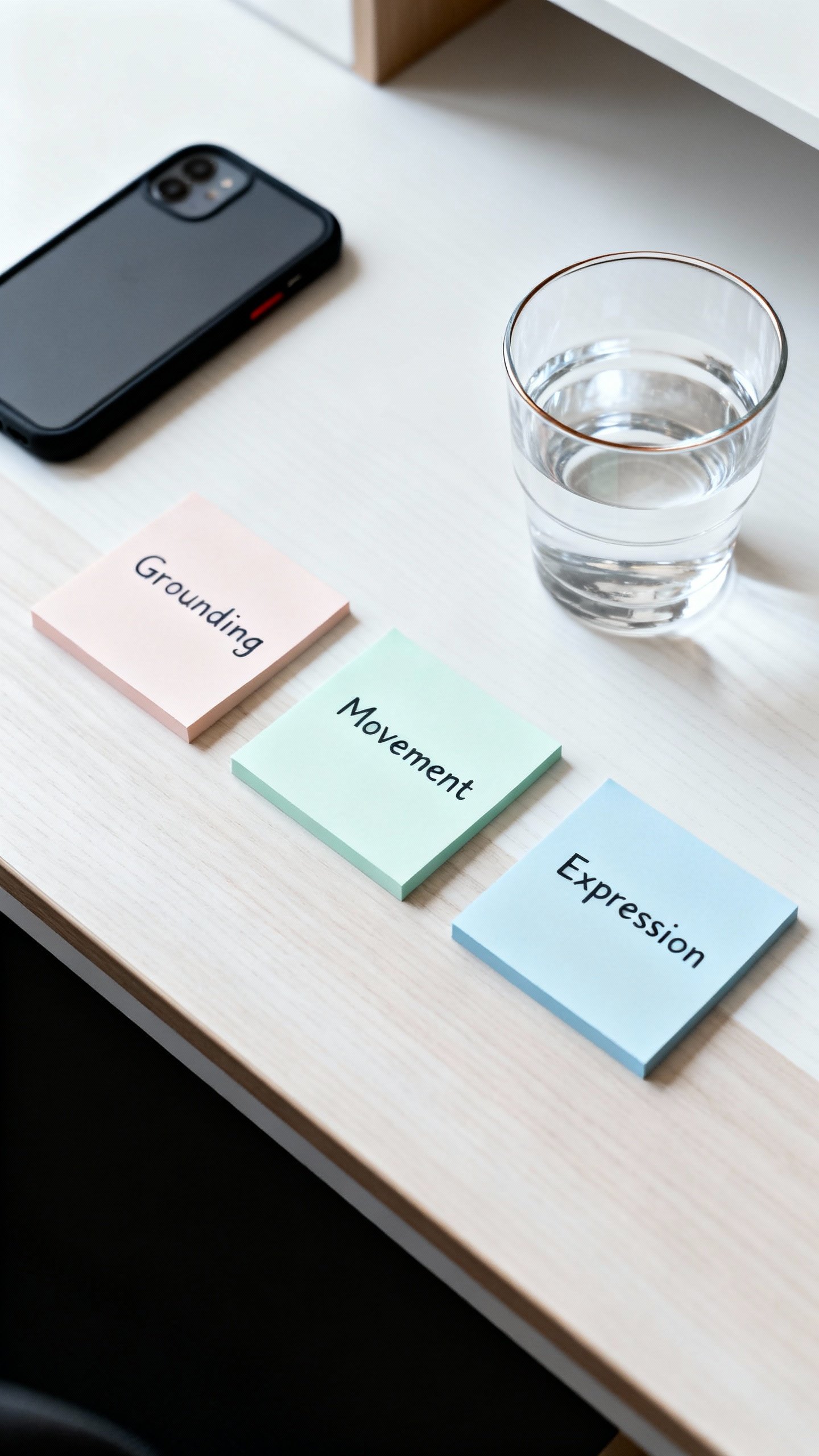
Rigid routines crack under real-life pressure. Build a menu of options so you can switch without spiraling.
Example Choice Board
- Grounding: Box breathing, 4-minute meditation, 2-minute cold splash.
- Movement: 10-minute walk, yoga flow, 15 push-ups, dance to one song.
- Expression: Journal, voice memo, doodle, text a trusted friend.
- Boundaries: Snooze notifications, say “I’ll get back to you,” schedule breaks.
Pick one from each category when you can.
On messy days, choose the shortest option. Consistency matters more than “ideal.”
Track What Matters (And Ignore What Doesn’t)
Self-awareness grows when you reflect on data you actually use. You don’t need a behavior lab.
You need a quick look back.
Weekly Review (10–15 minutes)
- What did I practice 3+ times? Celebrate it. Small wins stack fast.
- What drained me? People, tasks, environments—name specifics.
- What gave me energy? Double down next week.
- What pattern did I notice? E.g., late-night scrolling ruins mornings.
- One tweak: Add, remove, or shorten one element. Keep it tiny.
FYI: If tracking stresses you out, switch to emojis or a simple yes/no.
The best system is the one you’ll use.
Build Micro-Boundaries That Protect Your Routine
Your routine survives when you protect small pockets of space. Boundaries don’t need a speech—just clear actions.
- Time boundaries: Block 10-minute windows. Non-negotiable.
- Tech boundaries: Keep your phone out of reach during check-ins.
- People boundaries: “I’m unavailable from 8:10–8:20.
I’ll ping you after.”
- Work boundaries: No big decisions without a 2-minute pause first.
Scripts You Can Steal
- “I’ll need a minute to think—circle back in 10?”
- “Not today, but I can do Thursday.”
- “I’m offline after 6. I’ll respond tomorrow morning.”
Use the Feedback Loop: Feelings → Needs → Choices
Self-awareness turns useful when it changes your choices. Use a simple loop daily.
- Feelings: Name it—anxious, excited, resentful, overwhelmed.
- Needs: What would help—space, clarity, support, rest, movement?
- Choices: Do something small—ask for help, step outside, reschedule, breathe.
Repeat that loop long enough and you’ll stop outsourcing your decisions to stress and habit.
IMO, this is where the real growth happens.
Common Pitfalls (And How To Dodge Them)
- All-or-nothing thinking: Missed a day? Start again at the next anchor, not next Monday.
- Over-customizing: If your routine needs a user manual, simplify it.
- Chasing trends: If it doesn’t serve your why, skip it—even if TikTok says otherwise.
- Silent suffering: Self-awareness often asks for support. Text a friend or book a session when needed.
FAQ
How long should my self-care routine take each day?
Aim for 10–20 minutes total.
Use short anchors—morning, midday, evening. On wild days, do the 2-minute check-in and one breath practice. Consistency beats complexity every time.
What if journaling doesn’t work for me?
Try voice notes, one-line “captain’s log” entries, or sketching your mood.
The goal is reflection, not essays. If words feel heavy, describe body sensations or energy levels instead.
How do I stay motivated?
Tie your routine to your why and make success stupidly easy. Track streaks loosely, reward yourself (tea, music, a walk), and review weekly to notice actual changes.
Motivation follows momentum.
Can I do this if my schedule changes every day?
Yes—use the choice board and short anchors. Carry one non-negotiable (like a 2-minute check-in) everywhere. Place longer practices where your energy peaks, not at a fixed time.
What if I feel worse when I slow down?
That happens because you finally notice what you’ve been outrunning.
Start gently: shorter practices, grounding breath, and movement to discharge stress. If heavy feelings persist, consider talking to a professional—self-awareness should help you, not drown you.
How do I know it’s working?
You’ll pause more before reacting. You’ll spot patterns faster.
You’ll say no sooner. You’ll feel more “you,” even on messy days. That’s the win.
Conclusion
A self-care routine that builds self-awareness doesn’t demand perfection.
It asks for small, honest check-ins, a few body-based resets, and regular reflection. Keep your why in sight, protect tiny pockets of time, and tweak as you go. You’re not building a ritual to impress anyone—you’re building a rhythm that helps you notice yourself and choose better, one tiny decision at a time.