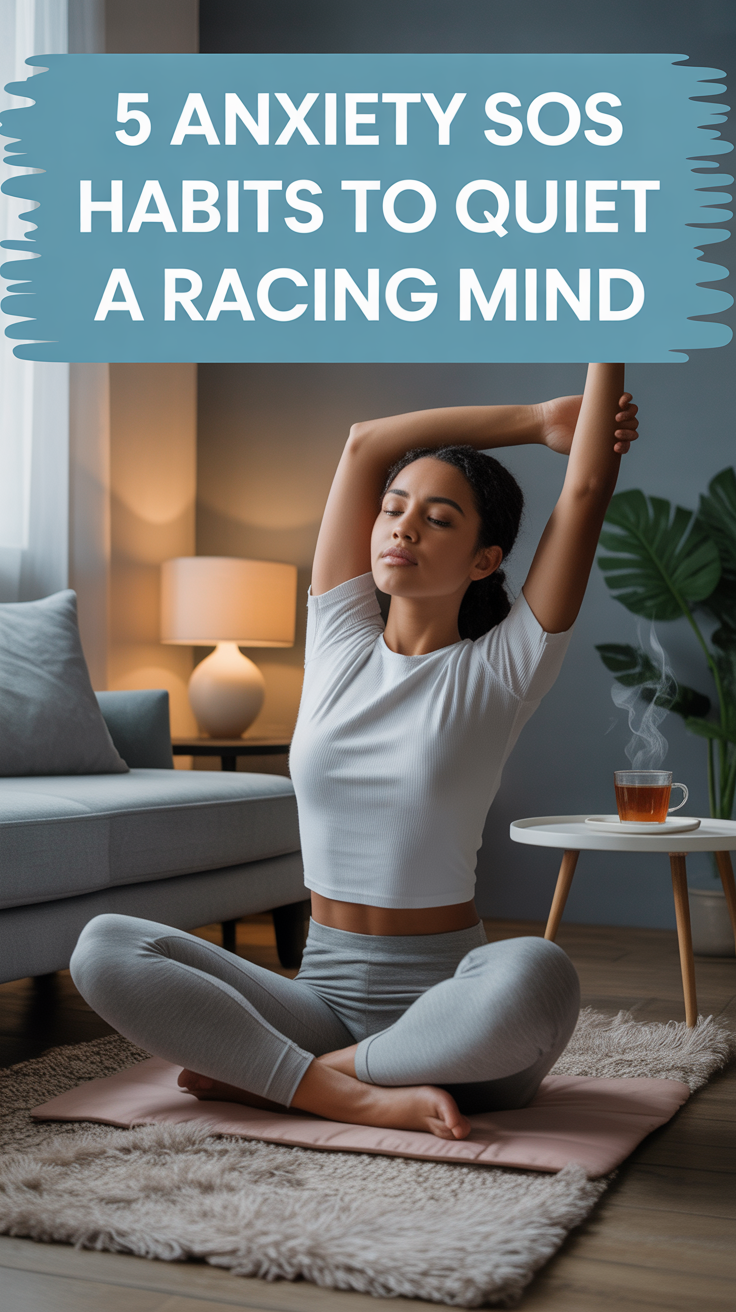
Your brain hits the gas pedal at 2 a.m. and refuses to tap the brakes. You’re not alone, and no, you didn’t forget how to “just relax.” Anxiety loves to audition worst-case scenarios and call it productivity. Let’s give your mind something better to do—five gentle, low-effort habits that help you shift gears without fighting yourself.
Start with your body: the 4-7-8 breath reset

Breathing sounds too simple, right?
Except your nervous system listens to your breath like it’s the group chat admin. Slow, intentional breaths tell your body you’re safe, even when your thoughts disagree.
- Inhale for 4 seconds through your nose.
- Hold for 7 seconds (soft belly, shoulders down).
- Exhale for 8 seconds through pursed lips (like blowing out a candle you’re not mad at).
- Repeat 4 rounds. That’s it.
Two minutes, tops.
You don’t need incense or a meditation cave. Do it in line at the pharmacy or under a too-bright office light. FYI: lightheaded means you’re breathing too hard—soften it.
Why it works
Your exhale length activates the parasympathetic system—your “rest-and-digest” crew. Longer exhale = calmer signals to your brain.
You’re not “fixing” thoughts. You’re changing the channel.
Give your worry a box (and a schedule)
Anxiety loves 24/7 airtime. Don’t fight it—contain it. Set a 10-minute “worry window” once a day.
Put it in your calendar like a weird meeting with your brain.
- During the day: when a worry shows up, jot it down and say, “You’re on tonight’s agenda.”
- During the window: read the list. Ask, “Is there a step I can take?” If yes, do a tiny step. If no, file it for tomorrow.
Worry vs. problem-solving
Worry is looping.
Problem-solving is doing. Convert one worry into one action:
- Worry: “I’ll mess up the presentation.”
- Action: run the first two slides out loud once. Done.
You trained your brain to trust you. That matters.
Move your edges, not the mountain
You don’t need a 60-minute workout.
You need 2-5 minutes of physical activation to bleed off the jitters. Think: short bursts, low drama.
- 30 seconds of brisk stairs + 30 seconds rest, repeat 3 times.
- 10 slow bodyweight squats + 10 wall pushups + 20-second plank.
- Walk outside for 5 minutes and name five blue things. Yes, blue.
IMO, your body sometimes just wants to move electricity around.
Give it a quick outlet and watch your mental static drop.
Make it frictionless
Put sneakers by the door. Put a jump rope near your desk. Reduce the setup time to near zero. Decision fatigue feeds anxiety—automation starves it.
Anchor to your senses (AKA: say hi to the room)
When your mind sprints into the future, your senses pull you back.
Try a 5-4-3-2-1 scan:
- 5 things you see
- 4 things you feel (socks, chair, air on skin)
- 3 things you hear
- 2 things you smell
- 1 thing you taste (or one slow breath)
Do it slow. Like, “grandparent showing you their garden” slow. You build attention like a muscle—reps matter more than intensity.
Upgrade with a touch anchor
Pick a small physical cue you use every time anxiety hits: press thumb to forefinger, feel your keys, touch your wrist. Pair it with one long exhale.
Your brain learns: this gesture = calm.

Write it out, but keep it tiny
You don’t need a four-page journal brain dump nightly. Try micro-journaling:
- Prompt 1: “What’s loud in my head right now?” (3 bullets)
- Prompt 2: “One thing I can influence today?” (1 line)
- Prompt 3: “One kind thing I’ll do for future me?” (1 line)
That’s under three minutes. It clears mental tabs.
And it gently shifts you from catastrophizing to choice-making. No fancy notebook required—notes app works fine.
Night mode version
If you wake up at 3 a.m., keep a notepad by your bed. Dump the thought, promise to revisit at your worry window, and go back to breathing. You’re not solving at 3 a.m.—you’re soothing.
Feed the calm circuit (yes, snacks matter)
Your brain runs on electricity and vibes—and also glucose and minerals.
Low blood sugar and dehydration often cosplay as anxiety. Stabilize basics:
- Eat protein + fiber at meals (eggs + toast, yogurt + berries, hummus + veg).
- Drink water before caffeine. Then keep sipping. Headaches lie.
- Magnesium-rich foods help (pumpkin seeds, dark greens, beans, dark chocolate—bless).
FYI: It’s not a cure; it’s a quieter foundation so you can use your tools.
Chaotic fuel = chaotic brain.
Caffeine rules, not laws
If you get the “doom zoom,” try:
- Half-caf or green tea before noon.
- Pair coffee with food, not an empty stomach.
- Cut the “last cup” 8 hours before bed.
Again, not moral purity. Just less rocket fuel on a bonfire.
Build a tiny “calm kit” you can actually use
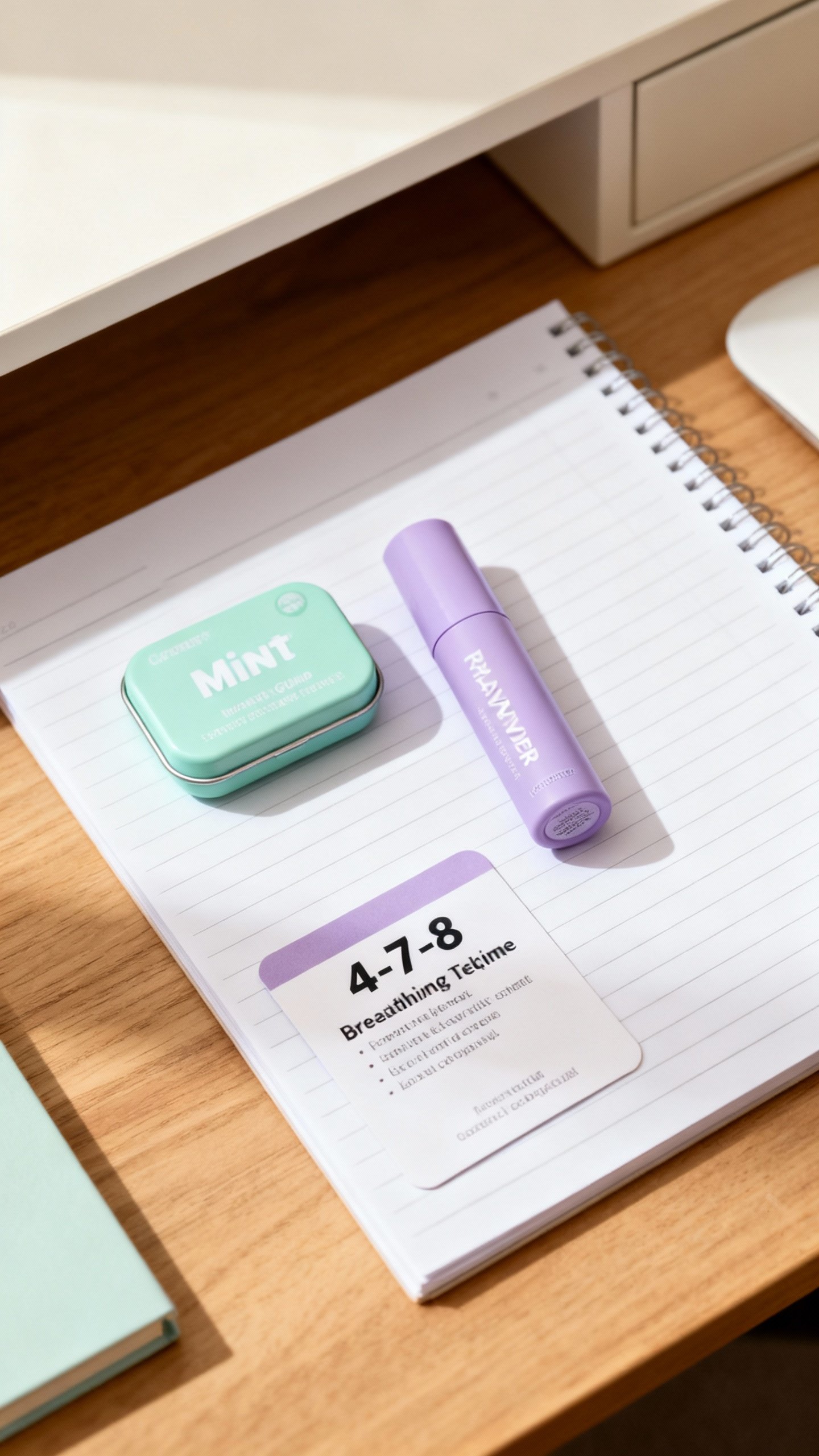
When you feel spun up, decisions get hard. Pre-pack a few tools:
- Breath cue: 4-7-8 card in your wallet.
- Sense anchor: mint gum or lavender roller.
- Movement: 2-minute playlist you only use for resets.
- Words: one phrase you trust, like “I can feel this and still function.”
Keep it simple enough that future-you won’t roll their eyes.
The goal? Press play, not overthink.
FAQ
How fast will these habits work?
Breath and sensory grounding can calm your body within minutes. Movement helps within 5-10 minutes. Food and sleep tweaks take days to weeks.
You’re not broken if it’s not instant—you’re human. Consistency matters more than intensity.
What if I try these and still feel awful?
You didn’t fail. Anxiety can hit like weather.
If your tools don’t cut it today, switch to the lowest-friction options: breathe, touch anchor, sip water, step outside. And if anxiety disrupts your life regularly, consider therapy or a medical check-in. Strong people ask for help; that’s the plot twist.
Do I need to meditate?
Nope.
Meditation helps many folks, but it’s not required. If sitting still makes your skin buzz, try “moving meditations”: walking, stretching, washing dishes with attention. You’re training focus either way.
Can I do all five habits daily?
Sure, but don’t make it a perfection quest.
Pick two that feel easiest. Use them on repeat until they’re automatic. Then stack a third.
Momentum beats motivation, IMO.
What if my thoughts feel catastrophic or scary?
Treat thoughts like notifications—some matter, some don’t. Label them: “That’s a worry story.” Then redirect to your body: breath, senses, movement. If thoughts turn dark or you feel unsafe, reach out to a professional or a crisis line in your area.
You deserve support.
Is technology making my anxiety worse?
Sometimes. Try guardrails, not shame: grayscale your phone after 9 p.m., move social apps off your home screen, and set a 10-minute “doomscroll cap.” Replace the last scroll with a short audio story or music. Tiny swaps, big payoff.
Wrapping it up (gently)
You don’t need to outsmart your anxiety.
You need to out-habit it. Breathe longer out than in. Put your worries on a schedule.
Move for two minutes. Touch the room with your senses. Feed your brain like you like it.
None of this turns you into a zen monk. It just gives you steering when your mind floors it. And honestly?
That’s enough to change the whole drive.