
Self-care isn’t a luxury spa day you schedule once a year and then forget. It’s the small everyday stuff that keeps your brain from turning into scrambled eggs. If your routine feels messy or nonexistent, a vision board can help you focus, commit, and actually enjoy the process.
Let’s build one that supports your wellness without turning into another guilt factory.
Get Clear On What “Self-Care” Actually Means (For You)
Self-care looks different for everyone. Some folks need more sleep and boundaries, others need play and sunlight. What do you actually want more of? Try this:
- List 5 feelings you want more often (calm, energized, confident, connected, proud).
- List 5 actions that would support those feelings (walks at lunch, therapy, journaling, Sunday meal prep, phone-free evenings).
- Pick 3 you can do weekly.Yes, just three. You’re not a robot.
Now your vision board can reflect outcomes and habits—not random pretty pictures that look nice and do nothing.
Choose a Format You’ll Actually Look At
Are you a tactile person or a tech person? Choose the format that you’ll see daily without effort.
- Analog board: Corkboard, poster, washi tape, magazines. Fun and satisfying.
- Digital board: Pinterest, Canva, Notion. Easy to update, lives on your phone.
- Hybrid: A small desk board + a matching phone wallpaper. Double exposure = better recall.
IMO, the best board is the one in your face every day.
If it lives in a closet or a forgotten app folder, it’s decor, not a tool.
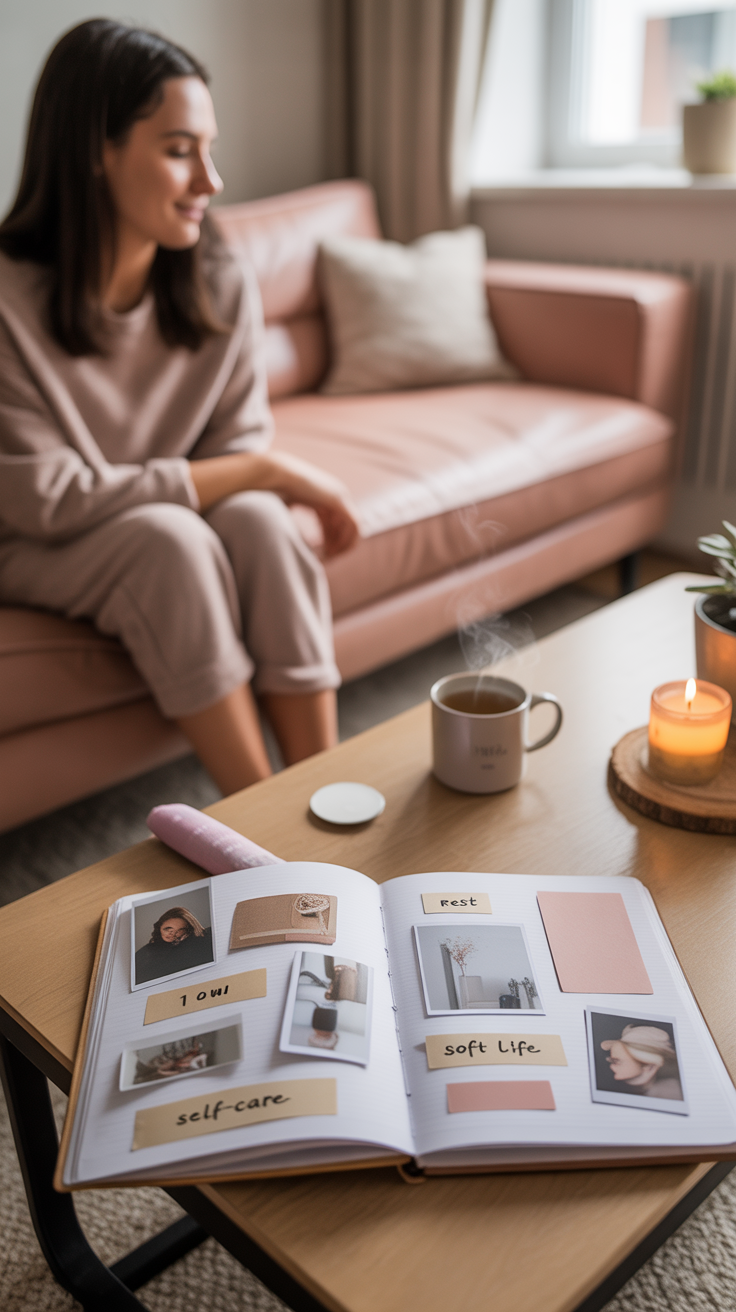
Build Around Themes, Not Random Aesthetics
Aesthetics matter—but themes guide behavior. Choose 3–5 themes that match your goals and give them a dedicated section on the board. Great themes for self-care:
- Sleep & Recovery: cozy bedding, wind-down routines, “lights out by 10:30.”
- Movement: walking trails, yoga, lifting, dance, mobility. Not punishment—joyful.
- Food & Energy: colorful meals, hydration reminders, Sunday grocery list.
- Mind & Mood: therapy notes, journaling cues, “say no without a paragraph.”
- Connection: weekly friend date, family calls, community events.
- Boundaries & Time: calendar visuals, “no meetings after 4,” phone-free blocks.
Translate Themes Into Visuals
Don’t just paste vibes.
Use images and words that cue action:
- A picture of your local park, not a random mountain in Switzerland you won’t visit.
- A screenshot of your alarm set for bedtime (hot, I know).
- Simple mantras like “move for 20 minutes,” “three colors on the plate,” or “two-minute tidy.”
Use The 3-3-3 Rule To Keep It Practical
When people make vision boards too grand, they ghost their goals. Keep it bite-sized with the 3-3-3 rule:
- 3 weekly habits: e.g., walk 3x, phone-free hour twice, meal prep once.
- 3 quick wins: e.g., drink water on waking, two-minute stretch, make the bed.
- 3 anchors: e.g., bedtime reminder, therapy appointment, Sunday reset.
FYI, quick wins build momentum. Momentum builds identity.
Identity sustains your routine when motivation takes a nap.
Stack Habits With Visual Prompts
Place the board where you do the habit, and link tasks to existing routines:
- Board by the coffee machine → “Journal while the kettle boils.”
- Board by the bed → “Read 10 pages after skincare.”
- Board by workout mat → “10-minute mobility before scrolling.”
Make It Measurable (Without Killing The Vibe)
You can keep things dreamy and still track progress. Add simple trackers to your board:
- Streak dots: Put a dot or sticker each day you do your habit.
- Weekly scoreboard: 3 boxes per habit—color them in by Sunday.
- Before/After feeling check: “Stress: 7 → 4 after walk.”
Why measure? Because your brain forgets wins faster than mistakes.
The board shows receipts. It proves the small stuff works—even when progress feels slow.
Use Words That Nudge, Not Nag
Skip guilt language (“Should, must, perfect”). Use supportive cues:
- “Try a 10-minute reset.”
- “One good meal changes the day.”
- “Bedtime is a gift to tomorrow-you.”
IMO, kindness beats discipline when we’re building habits that last.
Design For Frictionless Follow-Through
Make your future self’s life easier.
Lazy-proof the plan.
- Supply corners: Tape a little envelope to the board with stickers, a pen, and mini sticky notes.
- Visual shortcuts: Add QR codes (yes, really) to playlists, guided meditations, or your grocery list template.
- Prep cues: A printed “Sunday Reset” checklist: laundry, snacks, calendar review, clean sink, pick 3 workouts.
- Decision caps: “Max 2 choices: walk or stretch.” Decision fatigue is a motivation murderer.
Set Prompts For Hard Days
Plan for when you feel meh:
- Low-energy menu: “5-minute stretch, 10-minute walk, 1 fruit, 1 glass of water.”
- Emergency scripts: “I can’t make it today—can we reschedule next week?”
- Reset ritual: “Shower, comfy clothes, gentle music, one candle.”
Refresh The Board Monthly (Not Constantly)
Don’t rearrange your board daily because a new aesthetic trend hit your For You Page. Give it time to work.
- Weekly micro-review: Two minutes to add stickers, note wins, and adjust any blockers.
- Monthly refresh: Swap images, update goals, archive wins. Celebrate with a coffee and a 90s playlist.Non-negotiable.
- Quarterly theme check: Are your habits serving your core feelings? If not, pivot.
Track Wins Like a Dragon Tracks Gold
Keep a “win stack” envelope on the board. Collect:
- Printed step-count milestones
- Notes from you to you
- Photos of meals/movement/quiet mornings
When motivation dips, open the stash.
Instant proof you’re doing the thing.
Add Joy, Not Just Discipline
If your board feels like a performance review, you’ll avoid it. Add stuff that makes you grin:
- Inside jokes, pet photos, concert tickets, a sticker that says “hydrated and unbothered.”
- Rewards that match your values: new book after 12 workouts, fancy tea after 4 therapy sessions.
- Mini challenges: “7-day sunrise club,” “no snooze week,” “try 3 new recipes.”
FYI, joy is fuel. Most routines fail because we forget to enjoy them.
FAQ
Do I need to use photos of myself on the vision board?
You don’t have to, but it can help.
Photos of you doing the habit (post-walk glow, making breakfast, resting) anchor the board in reality. If that feels cringe, use images of your actual spaces—your kitchen, your park, your bed setup.
How much time should I spend making the board?
Give yourself 60–90 minutes for the first version. Then stop.
You’re building a tool, not a museum exhibit. Use it for a week, tweak for 10 minutes, repeat.
What if I fall off my routine for a while?
No drama. Use your low-energy menu and do one tiny action today.
Then update the board with a “restart plan” card. Consistency comes from restarts, not perfection.
Can I combine big goals with daily habits?
Yes—and you should. Pair a big vision (“run a 10k,” “sleep like a baby,” “less anxiety”) with tiny repeatable actions.
Add a mini roadmap: Week 1–2, Week 3–4, etc. Your board becomes a compass and a calendar in one.
Is digital or physical better for sticking with it?
Whichever you’ll see when decisions happen. If your phone tempts you to scroll instead of stretch, go physical.
If you travel a lot, digital wins. Hybrid gives you the best of both.
Conclusion
A solid self-care vision board doesn’t just look cute—it quietly engineers your best days. Keep it personal, practical, and a little playful.
Pick a few habits, build visual cues around them, and track tiny wins. Then refresh monthly, celebrate progress, and let the board nudge you toward the version of you who sleeps, moves, eats, and breathes like they actually matter—because you do.